Chancellor Friedrich Merz says his coalition has cleared a reform package as pressure grows to deliver growth. Meanwhile, a top court rejects complaints against the criminalization of childlike sex dolls. DW has more.
What you need to know
Chancellor Friedrich Merz says his coalition has approved a 'catalogue of significant reforms' after coalition talks in Berlin
The package includes €10 billion in income tax relief, an end to phone-based sick notes and plans to implement pension reforms
Germany's Federal Constitutional Court has upheld a ban on sex dolls with childlike features
A fire at a hospital in northern Germany has killed two patients
Here is a roundup of the latest headlines from Germany on Thursday, July 2, 2026:
Don't let the algorithm hide the news. If you rely on our team for trusted reporting, please take a moment to select us as your Preferred Source on Google by clicking here and hitting the "star" or "preferred" button, so you'll always see our verified news first.
Germany to ban state seizure of private rental homes
Germany 's coalition government has agreed to ban the nationalization of private rental housing in a bid to provide legal certainty for landlords.
"In order not to jeopardize private housing construction, a federal law will stipulate that the nationalization of private rental housing stocks through socialization laws at state level is no longer possible," read a statement release following a coalition committee meeting on Thursday.
Residents of the capital, Berlin , voted by a majority in 2021 in favor of expropriating large housing companies. The vote was not legally binding, but representatives of other federal states, such as North Rhine-Westphalia (NRW), are concerned about similar moves.
Chancellor Friedrich Merz claimed that questions were being asked "around the world about what is happening in Germany" and whether owners of housing companies can "expect expropriations in Germany."
However, in a bid to increase the supply of affordable homes, Merz's conservative CDU -led government also intends to set up a "housing construction company for affordable housing" with the aim of "building more housing in the affordable price segment, where the housing market does not permanently provide sufficient affordable housing."
Prosecutors seek life for Berlin palliative care doctor
Prosecutors have sought a life sentence for a Berlin palliative care doctor accused of murdering 15 patients .
They also asked for a finding that the defendant's guilt was particularly severe, a lifelong professional ban, and preventive detention.
The 41-year-old, who worked on the palliative care team of a nursing service that visited patients' homes, has been on trial for around a year.
Prosecutors say he killed 12 women and three men between September 2021 and July 2024, and set fires in some homes to cover his tracks.
According to the indictment, he gave patients an anesthetic and a muscle relaxant without a medical reason, causing respiratory paralysis and death within minutes.
The doctor has been in pre-trial detention since August 2024. Investigators initially suspected four killings, but the case later expanded. The alleged victims were aged between 25 and 94, and further suspected cases are still being reviewed.
In Germany, "life sentence" does not automatically mean prison until death. A life prisoner can usually seek parole after 15 years, but release depends on public safety and legal conditions. A finding of "severe gravity of guilt" can delay release beyond that.
A verdict is expected next week, or by August 10 at the latest.
DAX hits record high on AI optimism, global outlook
Germany's benchmark stock index has surged to a record high, driven by optimism over AI and easing geopolitical concerns.
The DAX rose 1.9% to 25,517 points, its highest level since January. Meanwhile, the Euro Stoxx 50 climbed 1.4% to around 6,370 points.
Investors are betting on continued growth in artificial intelligence , with tech-linked firms such as Infineon and Siemens Energy benefiting from expectations of rising electricity demand.
Hopes for a negotiated outcome in the Iran conflict have also buoyed market sentiment.
Analysts say the DAX is increasingly decoupling from Germany's weak domestic economy, as its globally active companies generate around 80% of their revenue abroad.
The index has already gained about 23% this year, marking its strongest performance since 2019.
Fuel prices top €2 again after subsidy ends
Fuel prices in Germany have risen above €2 per liter ($8.68 per US gallon) again after the end of the fuel tax rebate.
Data from the ADAC motorists' association showed that E10 unleaded gasoline averaged €2.016 per liter on Wednesday, the first time it's been above €2 since early May.
Diesel remained below €2 at €1.959 per liter, though that was also its highest level in weeks.
Prices rose by 9.3 cents for E10 and 10 cents for diesel compared with the previous day, less than the amount of the expired subsidy, after increases had already begun earlier in the week.
Industry representatives cited strong demand in anticipation of the end of the rebate, while the ADAC said prices had been elevated for weeks and the change had been priced in early.
Who is against the reforms?
The Verdi services trade union has sharply criticized the government's reform package, viewing the planned requirement for workers to provide a doctor's certificate from the first day of illness as an expression of a culture of mistrust.
"Mistrust toward employees and the expansion of the madness of fixed-term employment contracts do not create growth," said Frank Werneke, head of Verdi, which is Germany's second-largest trade union.
IG Metall, Germany's largest trade union, was more mixed in its response than Verdi, describing the package as a "mixed bag of light and shadow."
Christiane Benner, the union's chair, welcomed planned tax relief for workers. But she lamented the expansion of fixed-term employment contracts, calling it an "attack on workers' rights." She also opposed the abolition of telephone sick notes, saying it fulfilled employers' "antisocial wish list."
Felix Banaszak, co-leader of the Green Party , sharply criticized the government's reform package, saying it amounted to a "vote of no confidence in citizens."
The socialist Left Party condemned the coalition's reform package as a "program of mistrust and ignorance."
"A few euros less in taxes do not compensate for higher living costs, insecure pensions, and rising burdens in the healthcare system," the party leadership said.
Family doctors described the government's plans on sick notes as "absolutely catastrophic."
Markus Blumenthal-Beier, chairman of the German Medical Association, said the coalition was "accepting the complete overburdening of our doctors' practices."
He said it would lead to a "massive wave of bureaucracy" and longer waiting times for patients in need.
Who is in favor of the reforms?
Deutsche Bank CEO Christian Sewing welcomed the reform package, describing it as an important launchpad to restore Germany's competitiveness.
"This reform package is a very successful starting point and supports our call for reforms that promote growth, competitiveness and innovation," the head of Germany’s biggest bank said.
Sewing added that the government must now maintain that momentum, push ahead with implementation, and launch further reforms.
The German Insurance Association (GDV) warmly welcomed the governing coalition's measures aimed at boosting growth.
"What is now decisive is swift and consistent implementation as part of the parliamentary process," said GDV Managing Director Jörg Asmussen.
Rainer Dulger, president of the Confederation of German Employers' Associations, welcomed the coalition's reform package as a "long-overdue change of course."
Dulger said the package strengthened competitiveness and confidence.
However, Dulger also called for further measures, arguing that social security contributions remained too high and that there were no signs of relief for high performers and major contributors.
Germany's reform plan at a glance
Pensions: Implementing pension commission proposals, including a new investment-based element to Germany’s mainly pay-as-you-go state pension system, and gradually raising the retirement age over the coming decades.
Tax: Giving households around €10 billion in annual relief, partly funded by raising the top tax rate from 45% to 47% for very high earners.
Labour: Abolishing workers' ability to obtain sick notes by phone, requiring medical certificates from day one of sickness, and giving firms more flexibility on fixed-term contracts and dismissals for high earners.
Industry: Supporting strategic sectors including cars, chemicals, medicines, batteries, semiconductors, AI and clean tech.
Welfare: Tightening action against benefits fraud through more data sharing and stronger enforcement.
Energy: Speeding up electricity grid expansion and giving industry clearer grid-connection timelines.
Trade: Strengthening EU anti-dumping and anti-subsidy tools, with more scrutiny of strategic non-European investments.
Housing: Creating a federal housing company, supporting affordable housing and easing mortgage financing.
Bureaucracy: Cutting forms and reporting duties for companies, and automatically approving some applications if officials do not act within four months.
Farmers warn against ending minijobs
Germany's farming sector has warned that scrapping so-called minijobs in their current form — part of the package of reforms announced by the ruling coalition today — would hit the sector hard.
Minijobs are low-paid, low-hours jobs that currently allow employees to earn up to €603 a month with little or no employee social insurance burden. The coalition wants to abolish that special status, bringing minijobbers into the regular social-security system, with exceptions only for school pupils.
The president of the German Farmers' Association (DBV), Joachim Rukwied, said the proposal was "absolutely negative."
"We in agriculture — alongside the hospitality industry — rely heavily on mini-job workers." According to Rukwied, they assist with harvesting and sowing. "They are irreplaceable for us; consequently, this represents an additional burden on an agricultural sector that is already struggling to survive."
The changes are part of proposals linked to pension reform, which would integrate minijobs — currently capped at €603 per month — into the social security system and remove their special tax status.
Under the plans, exemptions would largely be limited to school students.
Tropical fruits fresh from Germany
To view this video please enable JavaScript, and consider upgrading to a web browser that supports HTML5 video
'This day will be a good day for Germany'
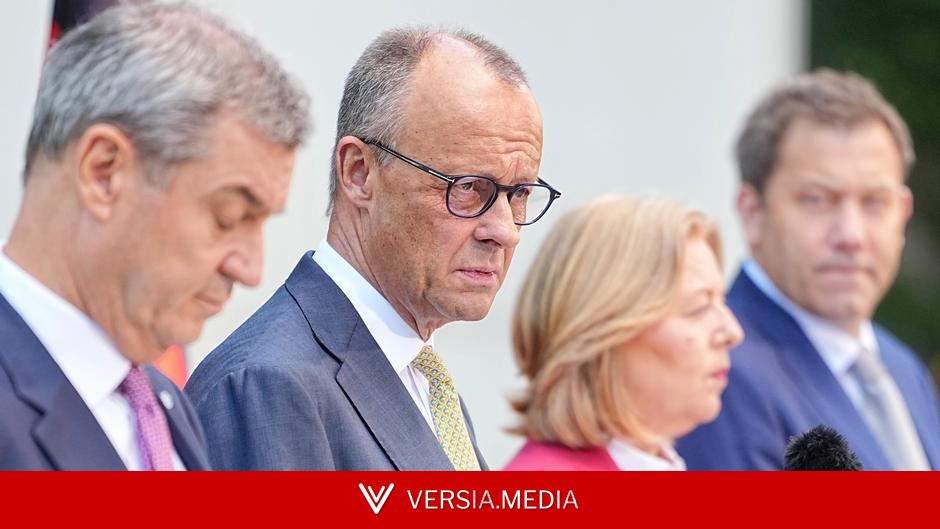
The fresh air, bright sunshine and the view of a vast construction site in the background were meant to convey a sense of renewal and a fresh start to what one of Merz's aides described as a "summer of reforms."
Merz appeared pleased as he announced an agreement on a broad package of reforms after just seven hours of negotiations — a remarkably short timeframe for a coalition of Christian Democrats and Social Democrats, whose relations have often been strained in recent months.
The chancellor used lots of slogans about wanting to make Germany economically fit again. "This day will be a good day for Germany. The political center has to show that we can give the country direction." His message in a nutshell: Yes, we can.
The negotiations were widely seen as a make-or-break moment for the coalition parties, whose approval ratings have remained low.
Germany charges Ukrainian national over Nord Stream blasts
German federal prosecutors have filed charges against a Ukrainian national over a series of blasts on the Nord Stream pipeline in September 2022.
The 50-year-old Ukrainian soldier from Kyiv is accused of leading a team of seven accomplices in the operation, which destroyed three of four key gas conduits.
Hospital fire in Germany leaves two dead
A fire at a hospital in northern Germany has left two patients dead, regional officials have said.
Authorities said the blaze is believed to have started in a patient’s room before spreading to the roof in the early hours.
Health institute logs 810 heat-related deaths in 2026, excluding last week's heat wave
Germany's RKI public health institute estimates that 810 people have died with hot weather a contributing factor between the start of the year and June 25, 2026.
The Robert Koch Institute's new figures published on Thursday do not include last week's period of extreme heat and so seem liable to rise by the next installment.
Only a small number of the RKI's heat-related deaths are heat stroke and other cases of hot temperatures directly causing death. More common are cases where heat exposure exacerbated pre-existing conditions and led to death. The elderly, particularly over-85's, are proportionally most affected.
For now, the 2026 figures are low when compared to past years, but they only include a few weeks very early in the northern hemisphere's summer, so the peak period for heat-related deaths is yet to be recorded.
The most lethal year on record recently is 2018, another El Nino year , when the RKI attributed more than 8,000 deaths at least in part to hot weather.
Extreme heat: Can Europe adapt to climate change?
To view this video please enable JavaScript, and consider upgrading to a web browser that supports HTML5 video
German businessmen admit sanctions breach over Russia exports
Two businessmen have confessed to illegally exporting industrial equipment to Russia in violation of EU sanctions.
Prosecutors said the German-Russian brothers, aged 34 and 39, shipped machinery parts worth more than €830,000 ($945,755) via third countries despite restrictions linked to the war in Ukraine .
The case is being heard at the regional court in Münster, where the pair admitted 65 violations of Germany’s foreign trade laws.
According to investigators, goods were routed through shell companies in Kyrgyzstan and Turkey before reaching Russia.
The brothers said their father, who faces separate proceedings, had pushed them to continue the business. "We knew what we were getting ourselves into," one told the court.
Under a deal to avoid a lengthy trial, both face potential sentences of up to four years and eight months.
Court upholds ban on childlike sex dolls in Germany
Germany's top court has upheld a ban on sex dolls with childlike features.
The Federal Constitutional Court rejected constitutional complaints against the law, ruling that restrictions on personal rights are justified.
The regulation, introduced in 2021, criminalizes the production, sale, purchase and possession of such dolls.
The complainants had argued the law violated their right to sexual self-determination, but the court disagreed.
Under the law, producing or distributing the dolls can carry prison terms of up to five years, while possession or purchase can lead to up to three years in jail or fines.
What did the other coalition leaders say?
Appearing alongside Chancellor Friedrich Merz at the chancellery garden press conference, the three other leaders of the coalition parties enthusiastically hailed the reforms.
The co-leader of the center-left Social Democrats (SPD), Finance Minister Lars Klingbeil , said he believed the reforms would enjoy widespread pubic support, with an emphasis on fairness.
The coalition had "agreed on solutions that can be supported by a broad majority of our society," said Klingbeil, adding that he was "firmly convinced that these decisions will give our country new strength."
SPD co-leader Bärbel Bas said the package would "indeed ensure that the economy grows again, that we achieve growth and secure jobs, while maintaining social balance, and, above all, that we strengthen cohesion within our country."
Meanwhile, the leader of Bavaria's conservative Christian Social Union, Markus Söder , described the package as "well-rounded."
Each coalition partner would have liked to see more in certain areas, he said. "But a coalition means compromise."
"We are making progress," said Söder. While the package was not a "big bang" in itself, he noted, it was another step away from economic stagnation.